
Why CO2
Supercritical CO₂ extraction (scCO₂): principles, benefits, applications and equipment
What Is Supercritical CO₂?
Supercritical carbon dioxide (scCO₂) is CO₂ brought to specific conditions (above 31.1 °C and 73.8 bar), where it becomes a “supercritical fluid” — a unique state combining the properties of both a gas and a liquid. This makes it an ideal solvent for precise, clean and efficient extraction.
In this state, CO₂ diffuses like a gas and dissolves like a liquid, allowing it to penetrate deep into solid matrices and extract target compounds with high efficiency. Its solvent power can be finely tuned by adjusting temperature and pressure to optimize solubility for specific molecules.
- High solubility and selectivity
- Fast diffusion and low viscosity
- Tunable solvent power through pressure and temperature
- Selective targeting of compounds based on their chemical properties

Eco-Friendly and Sustainable
Supercritical CO₂ extraction follows the principles of green chemistry. It replaces toxic organic solvents with a non-toxic, non-flammable and recyclable alternative.
The CO₂ used in supercritical extraction is often recovered as a by-product of other industrial processes, such as fermentation or ammonia production, making it a low-impact option that can be considered carbon neutral. In systems equipped with a recycling loop, the CO₂ can be reused in a closed circuit, helping to reduce CO₂ consumption and process-related releases.
- Zero solvent residue in extracts
- No hazardous waste generation
- Closed-loop CO₂ reuse where supported by the system configuration
- CO₂ sourced from industrial by-products for a lower environmental impact
- Reduced energy consumption compared with distillation or evaporation
High-Quality Extraction Results
The moderate temperatures used in scCO₂ extraction preserve the structural and functional integrity of sensitive compounds such as terpenes, flavonoids and essential oils. The process is suitable for both fresh and dried raw materials.
Unlike conventional solvent extraction, scCO₂ limits thermal degradation and unwanted chemical changes. The resulting extracts are often purer, more stable and do not require additional purification steps to remove solvent residues.
Principle of the Extraction Process
As it passes through the autoclave, the CO₂ in its supercritical state becomes loaded with the various compounds extracted from the raw material. This produces a more or less complex mixture made up of molecules that may have different physicochemical properties.
The way these compounds are subsequently recovered depends in particular on the number of separators installed in the system.
Pump-free extraction
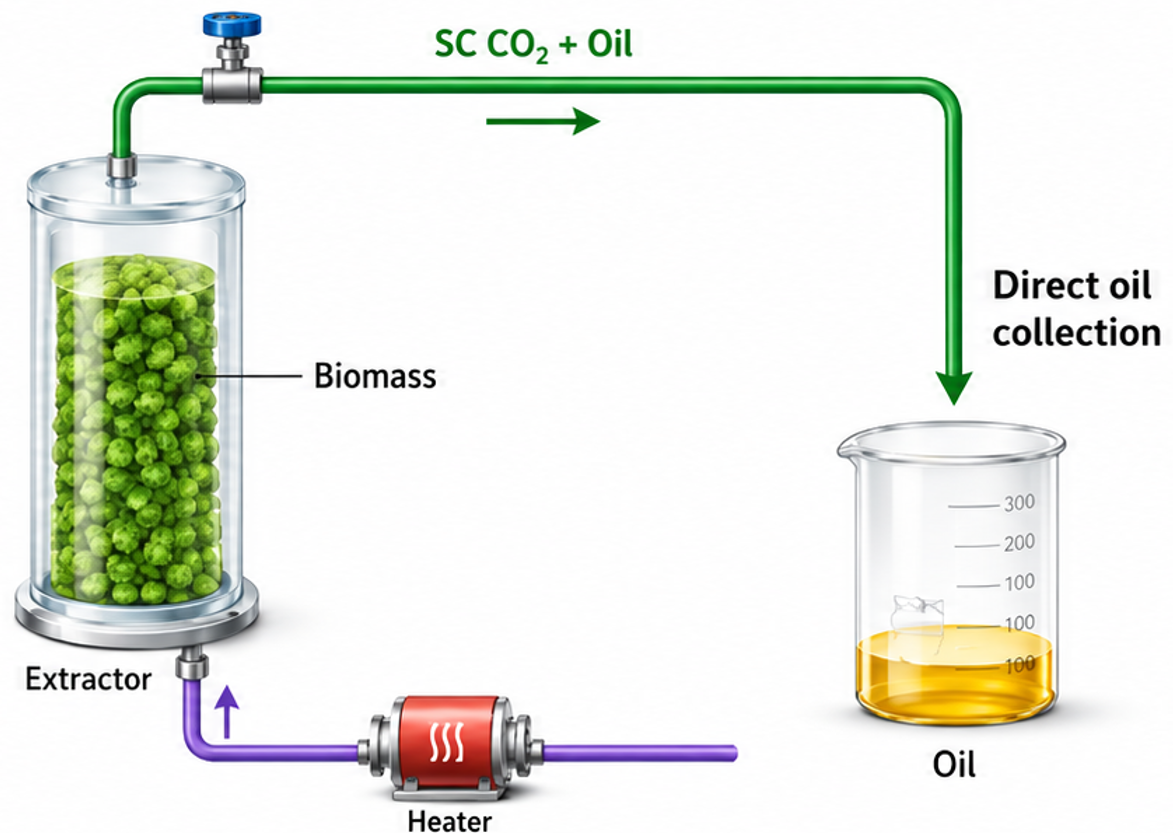
Closed-loop CO₂ recycling system
With 1 autoclave and no separator – Pump-Free Extractor
In this configuration, the CO₂ is not recycled. Extraction is carried out in a single step in the autoclave and produces a qualitative, but not quantitative, mixture whose composition may be more or less complex.
The profile of the resulting extract depends directly on the pressure and temperature conditions applied to the supercritical CO₂ in the autoclave. The pressure/temperature pair therefore acts, in a sense, as the “signature” of the extraction conditions.
Examples of equipment operating with one autoclave: ANTON 100 ml extractor and EASYONE 125, 250 or 500 ml extractor.
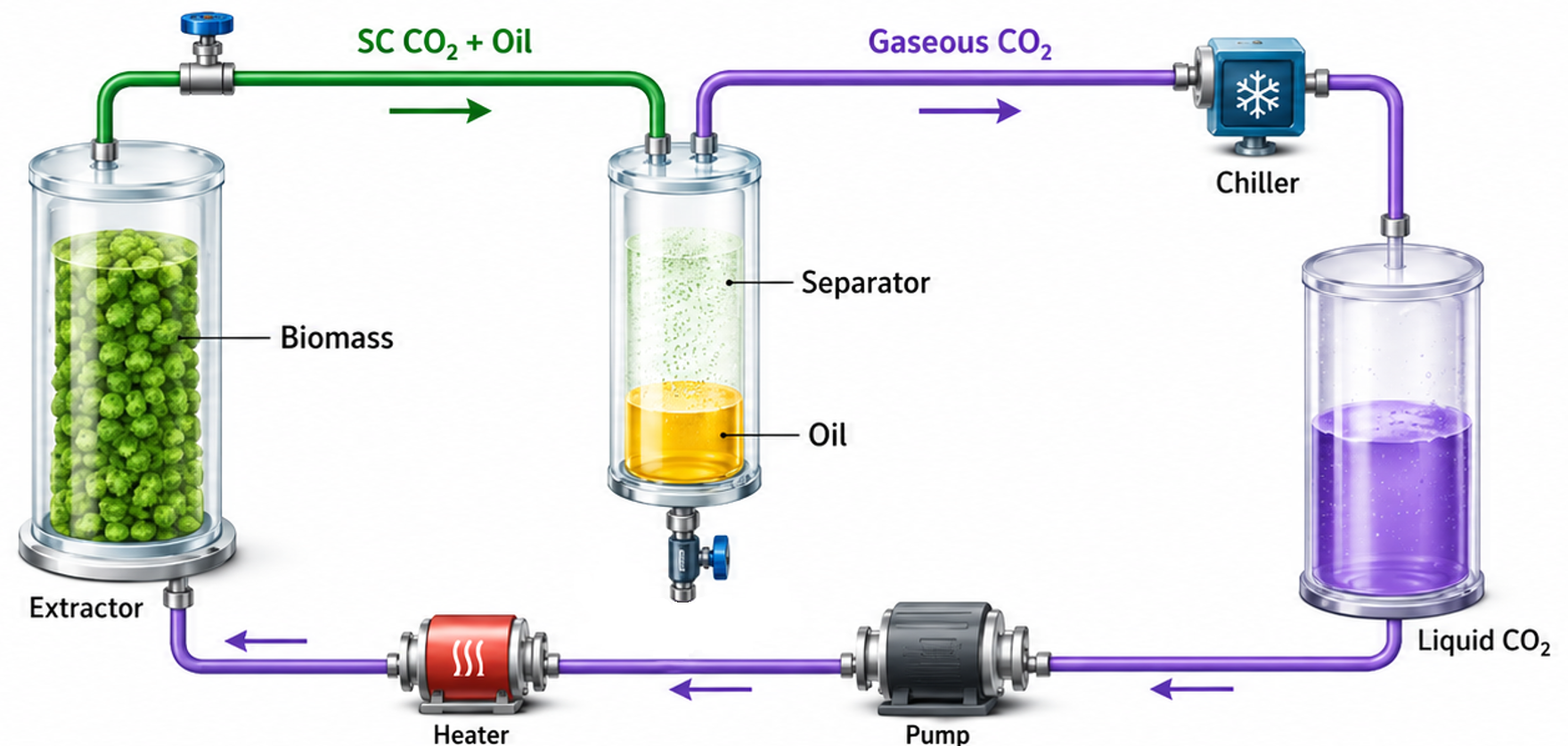
With 1 autoclave and 2 separators – Extraction with pump
In this configuration, the CO₂ operates in a recycled loop. Extraction of the compounds takes place in the autoclave. As above, the nature and composition of the extract depend mainly on the pressure/temperature pair applied to the supercritical CO₂ in the autoclave.
The first separator then enables a mixture to be recovered both qualitatively and quantitatively.
The second separator mainly provides the final separation of the CO₂. It is maintained at a pressure and temperature that allow the CO₂ to be completely gaseous. Any compounds still carried by the flow can therefore be condensed and recovered.
The gaseous CO₂ leaving the separator is then directed to a heat exchanger (condenser), where it is cooled and returned to a 100 % liquid state. It can then be pumped again and reinjected into the extraction circuit.
With 1 autoclave and 3 separators – Extraction with pump
In this configuration, the CO₂ is also recycled, but the system allows the extract to be fractionated in two successive stages.
In the first separator, the pressure is reduced compared with the autoclave while maintaining conditions that allow the CO₂ to retain significant solvent power in the supercritical state. This change in operating conditions causes the preferential precipitation of certain compounds, particularly heavier molecules that have become less soluble. These form a first fraction.
The fluid carrying the remaining compounds then continues to the second separator. A new pressure/temperature pair is applied there to modify the solvent power of the CO₂ again and recover a second fraction, generally consisting of compounds with solubility characteristics different from those of the first fraction.
The third and final separator provides the final separation of the CO₂. Pressure and temperature are adjusted so that the CO₂ becomes completely gaseous. Any remaining entrained substances are then condensed and recovered.
The gaseous CO₂ is then cooled in a heat exchanger until it is 100 % liquefied, before being returned to the pump for reuse in the process.
Note: depending on the required degree of fractionation, a system may include more than three separators.
Broad Industrial Applications
Supercritical CO₂ is used across many industries thanks to its flexibility, safety and efficiency:
- Food & Beverages: decaffeination of coffee and tea, extraction of aromas, essential oils, pigments and antioxidants
- Pharmaceuticals: purification of active pharmaceutical ingredients (APIs), encapsulation, sterilization and formulation of drug carriers
- Cosmetics: extraction of natural active ingredients, fragrance isolation and formulation of clean-label products
- Materials Science: micronization, particle formation (RESS, SAS, PGSS), aerogel synthesis, coating and surface modification
- Environmental Applications: soil remediation, contaminant removal and waste-stream valorization
A Safer Alternative to Conventional Solvents
Traditional extraction methods often rely on organic solvents such as hexane, ethanol, acetone or ethyl acetate. These solvents can present safety, environmental and health risks. In contrast, scCO₂ offers:
- No toxic residues in the final product
- Improved safety for operators and consumers
- No explosion or fire risk because CO₂ is non-flammable
- Fewer regulatory constraints in the food, pharmaceutical and cosmetics industries
- Often simplified regulatory validation for products using scCO₂ extracts
Ready to Use Supercritical CO₂?
Let’s explore how this clean and efficient technology can improve your extraction process.
Contact Us